
Enquiries come in. Nobody calls back.
Not because anyone is lazy. The person who should have phoned was under a sink at the time, and by Thursday the message is four screens down. None of this work is clever. It is a machine remembering the thing a busy person was always going to forget.
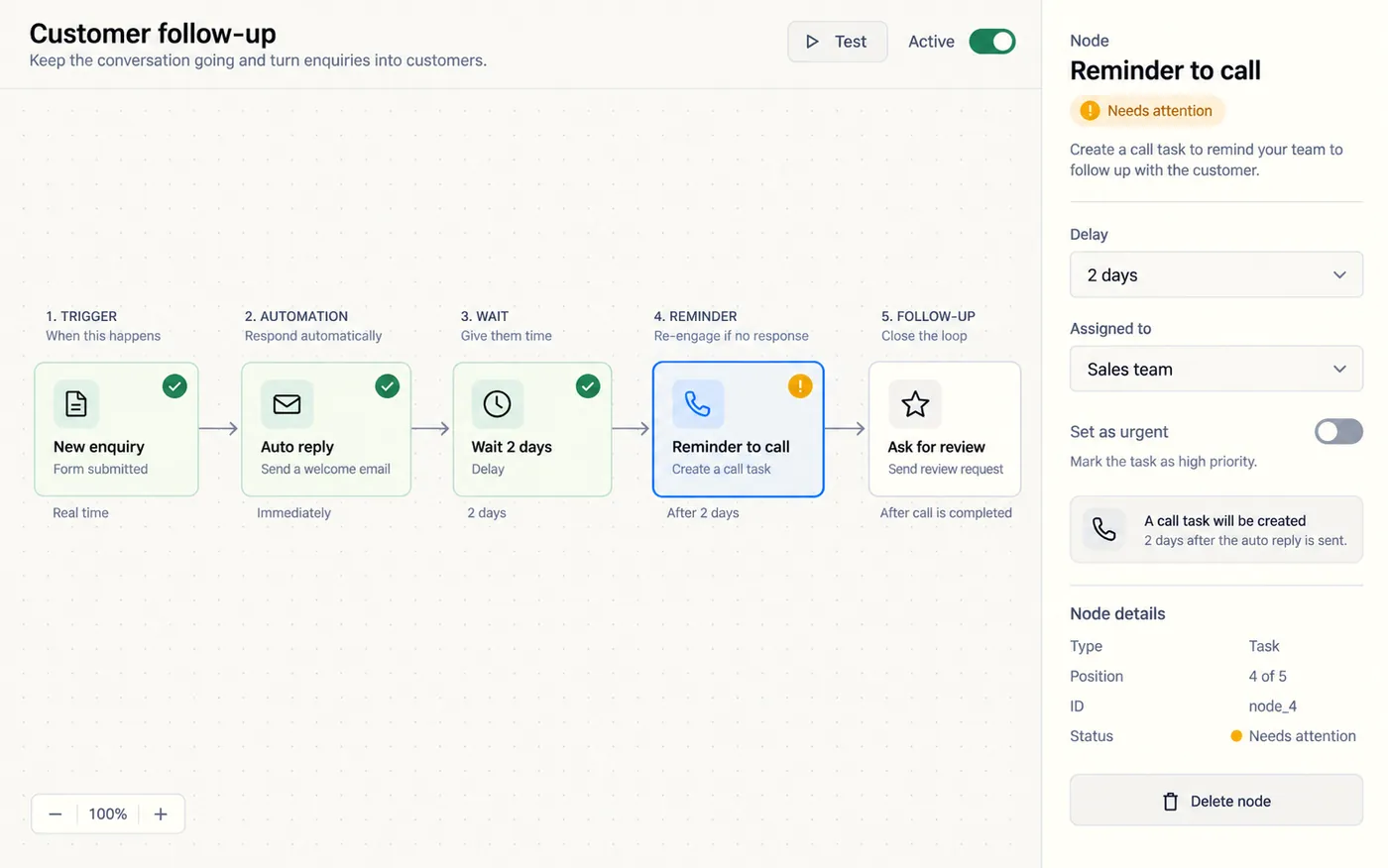
Five steps, and nobody has to remember any of them.
- 01
Something arrives
Web form, email, Facebook message or a missed call. All four land in the same list instead of four different places.
- 02
It gets answered
Within a minute, in your words, saying what happens next and when. The customer knows they were heard while they are still on the site.
- 03
It waits
Two days, or whatever matches how you actually work. Nothing happens yet, and nothing gets forgotten either.
- 04
Somebody gets nagged
A reminder to call, aimed at a named person, that keeps coming back until the task is marked done rather than dismissed.
- 05
The job asks for a review
After it is finished, to every customer, with nothing offered in return. Google's policy prohibits incentives and selectively soliciting positive reviews.
Most of this runs on tools you are already paying for. Where a new one is needed I name it and its price before I set it up.
Days, not weeks.
- Typical setup
- Enquiry capture, auto reply, reminder, review request
- Time to live
- Days, not weeks
- What I need from you
- Access to your inbox or CRM, and how you would normally reply
- Starts at
- $400
- Ads & SEO
- On request
The tooling is usually something you already pay for. Where it isn't, the monthly cost is itemised separately from my fee.
Every enquiry answered, even at four on a Friday.
One list of everything that came in, an immediate first reply so the customer is not sitting in silence, and a reminder pointed at whoever has to make the call. The reply is written once, by you, and then it just happens.
- Web form, email, Facebook and missed calls in one place
- A first reply that reads like a person wrote it, because one did
- A reminder that keeps coming back until somebody acts
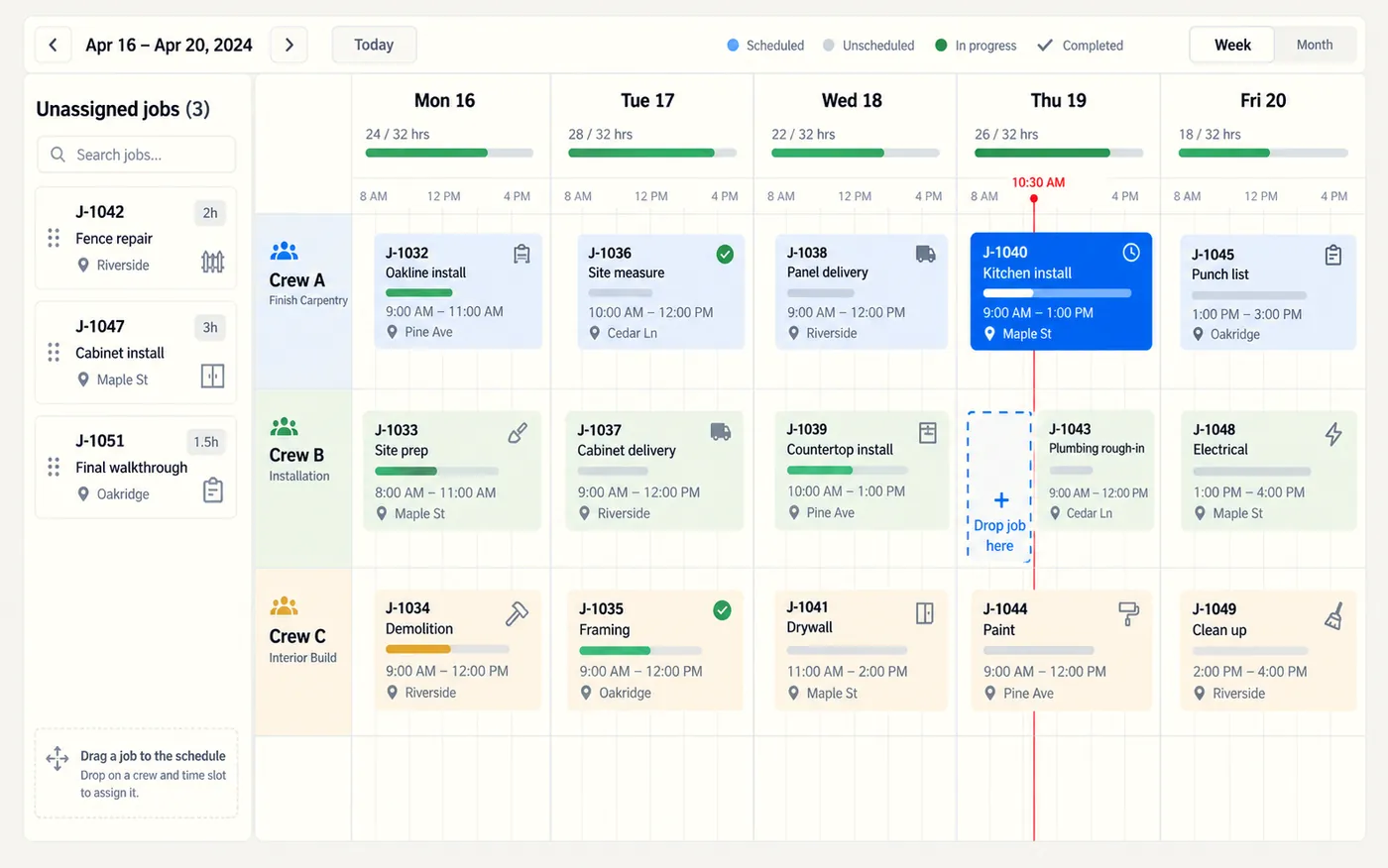
The crew knows where they are going.
A week everyone can see, a summary that sends itself before anyone starts driving, and a record of what actually happened rather than what was planned on Monday.
- Jobs assigned to people and days, visible to all of them
- Unassigned work impossible to miss
- What happened kept, so Friday's argument has an answer
Asked for properly, or not at all.
After every finished job the request goes out. To everyone — not only the customers you expect to be kind — and with nothing attached to it. No discount, no draw, no "we'll take ten off".
If you want to thank customers, that goes out separately and unconditionally, with no mention of a review in it. That separation is the whole trick, and it costs nothing.
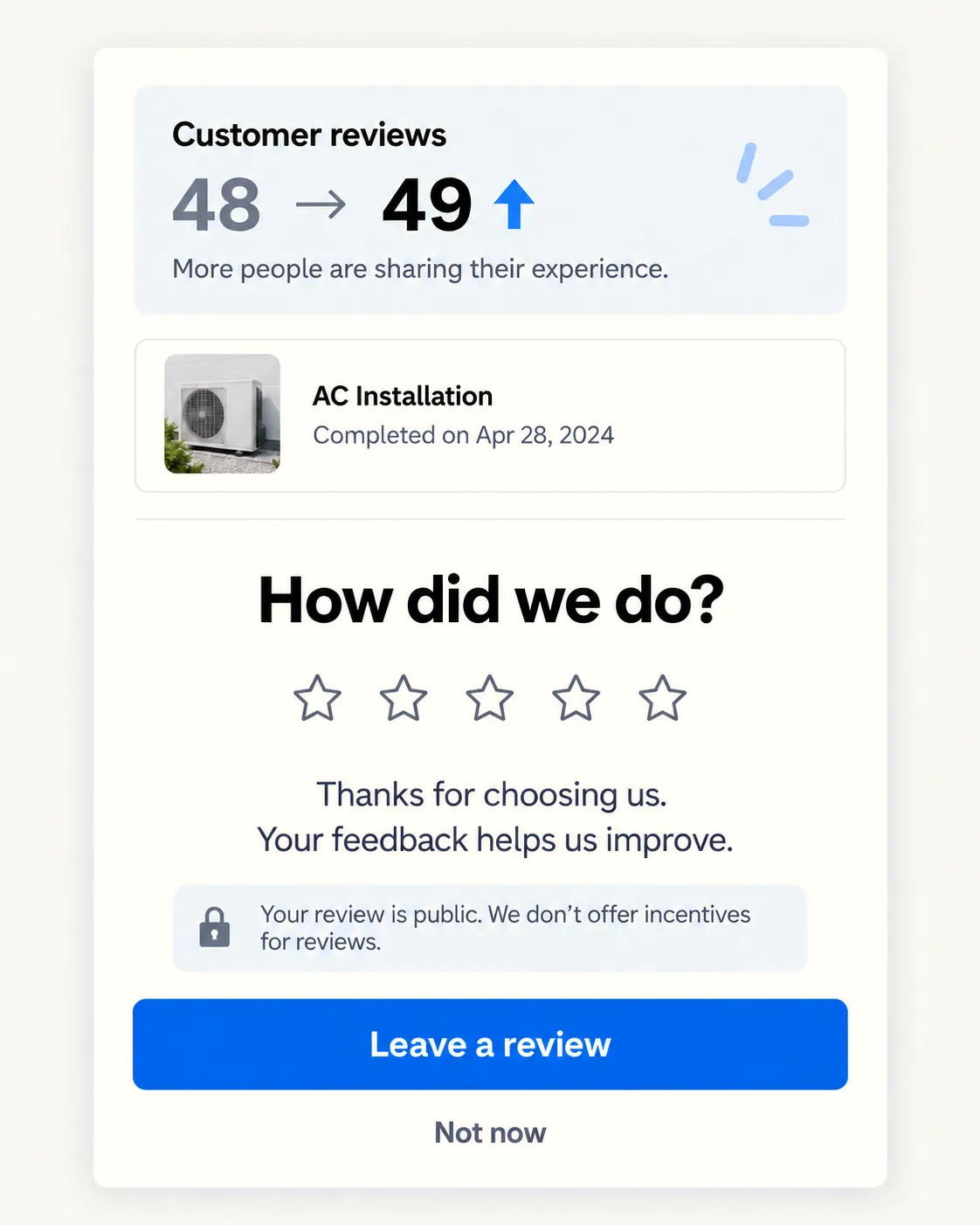
I will not build review gating, and I will not attach a discount to a review. Google's policy forbids both, and Canada's Competition Act prohibits materially false or misleading representations, including deceptive reviews.
This is not caution. Ask everyone, offer nothing, and you end up with more reviews than the business down the road that got its account flagged.
Where the first money should go.
Here, first
Answering the enquiries you already get, and collecting reviews from the jobs you already finish. It compounds, it costs almost nothing to run, and it makes every dollar you later spend on advertising work harder.
Ads, later
Paid traffic pointed at a business that does not answer its enquiries is a way of paying for the privilege of losing them. Once the follow-up works, ads are worth a conversation, and I quote them then rather than now.
What I work in here
Questions about follow-up and reviews
Can we offer a discount for leaving a review?
No, and I will not build it. Google's policy forbids incentives and selectively soliciting positive reviews. Canada's Competition Act also prohibits materially false or misleading representations, including deceptive reviews. Ask every customer, offer nothing, and send any thank-you separately and unconditionally.
Is cold email to businesses legal in Canada?
Under CASL, only under specific conditions: a published address that carries no statement refusing such messages, a message genuinely relevant to that person's role, your own identification in it, and an unsubscribe that works. The burden of proving consent sits with the sender, so anything I build for you keeps a record of where each address came from.
Do you manage ad accounts month to month?
On request, and I would rather not take it on until the follow-up works. I run Google Ads for a local business and audit the account on a schedule rather than glancing at it when the invoice arrives.
What does this cost to run afterwards?
Often nothing new — the automation sits on a platform you already pay for. Where a new tool is needed it is typically $20–100 a month depending on volume, itemised separately from my fee so the two are never confused.
How many enquiries are you losing?
The audit counts the places where somebody has to remember to do something, and says which of them a machine should be doing instead.