
Four ways in. One place to land.
An illustration of what I build, not a client project. Every small business takes orders through whatever channel the customer felt like using that morning, and then spends the week reconstructing what was agreed.
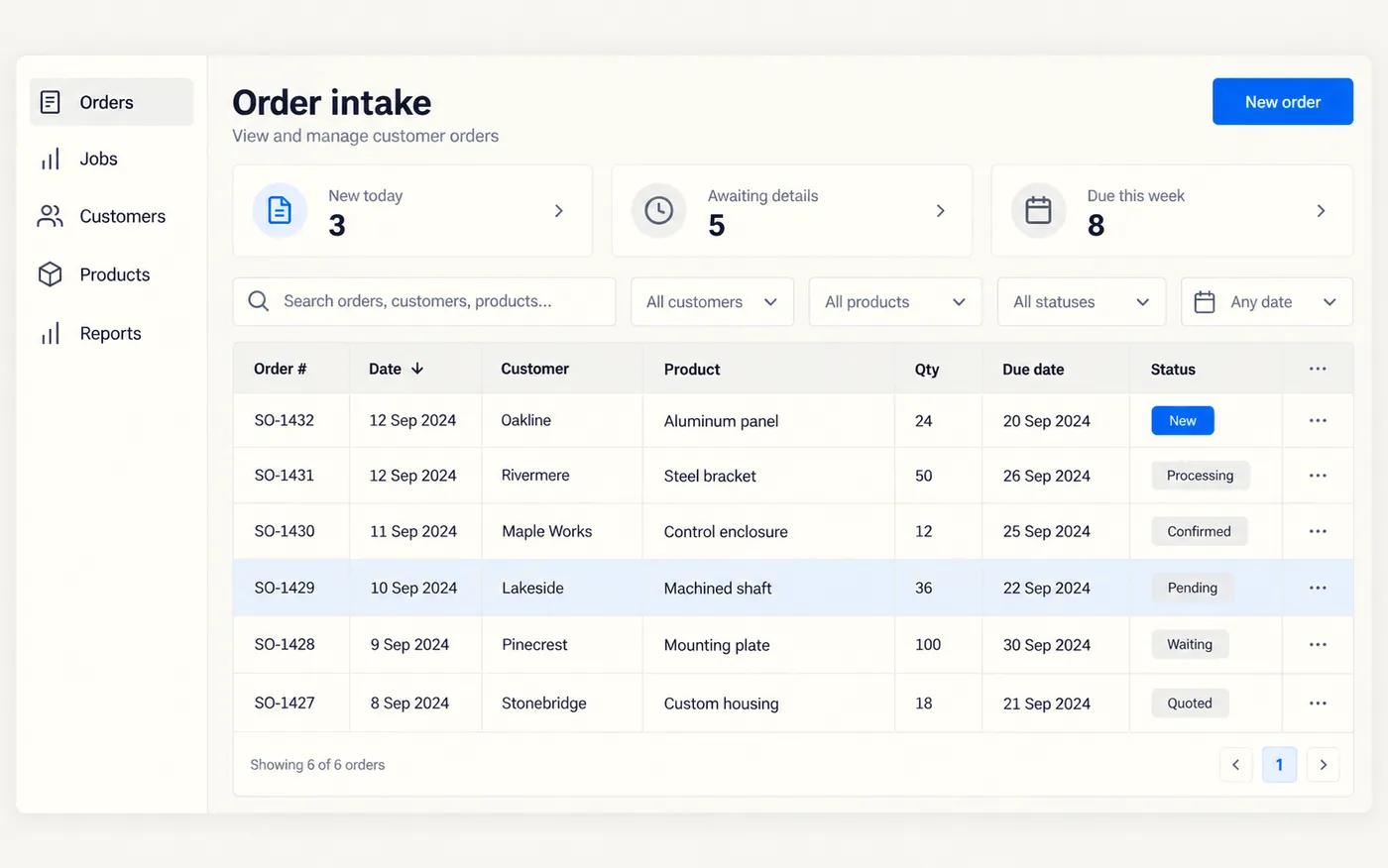
Each one loses something different.
The phone call
Taken at eight in the morning by whoever was nearest the phone. The quantity is right, the deadline is a guess, and the sizes were agreed out loud.
Nothing about it is written down until somebody needs it, and by then the details have drifted. The cost shows up two weeks later as a job started from the wrong spec.
The email with an attachment
Forwarded twice, answered once. The artwork is in the second message and nobody ever downloaded it.
A fortnight later the thread is buried under ninety others and the file goes with it. Somebody asks the customer to send it again, which is the moment they start wondering how organised you are.
The form and the message
A website form posting into an inbox nobody watches, and a Facebook message answered on somebody's personal phone on a Saturday.
Both are real orders. Neither is anywhere the rest of the business can see, and if that person is off sick on Monday, neither exists.
The parts that matter
- One shape
- Every order captured with the same fields, whichever channel it arrived through
- Files attached
- Artwork, drawings and measurements live on the order, not in somebody's inbox
- Nothing missing
- The form refuses to submit without the things you always end up chasing
- One status
- So whoever answers the phone can say where the job is without asking anybody
- Phone orders too
- The same form, filled in by whoever took the call. Thirty seconds, not a notebook
- Straight into the work
- An accepted order becomes a job on the board without being typed a second time
Both ends of the same order.
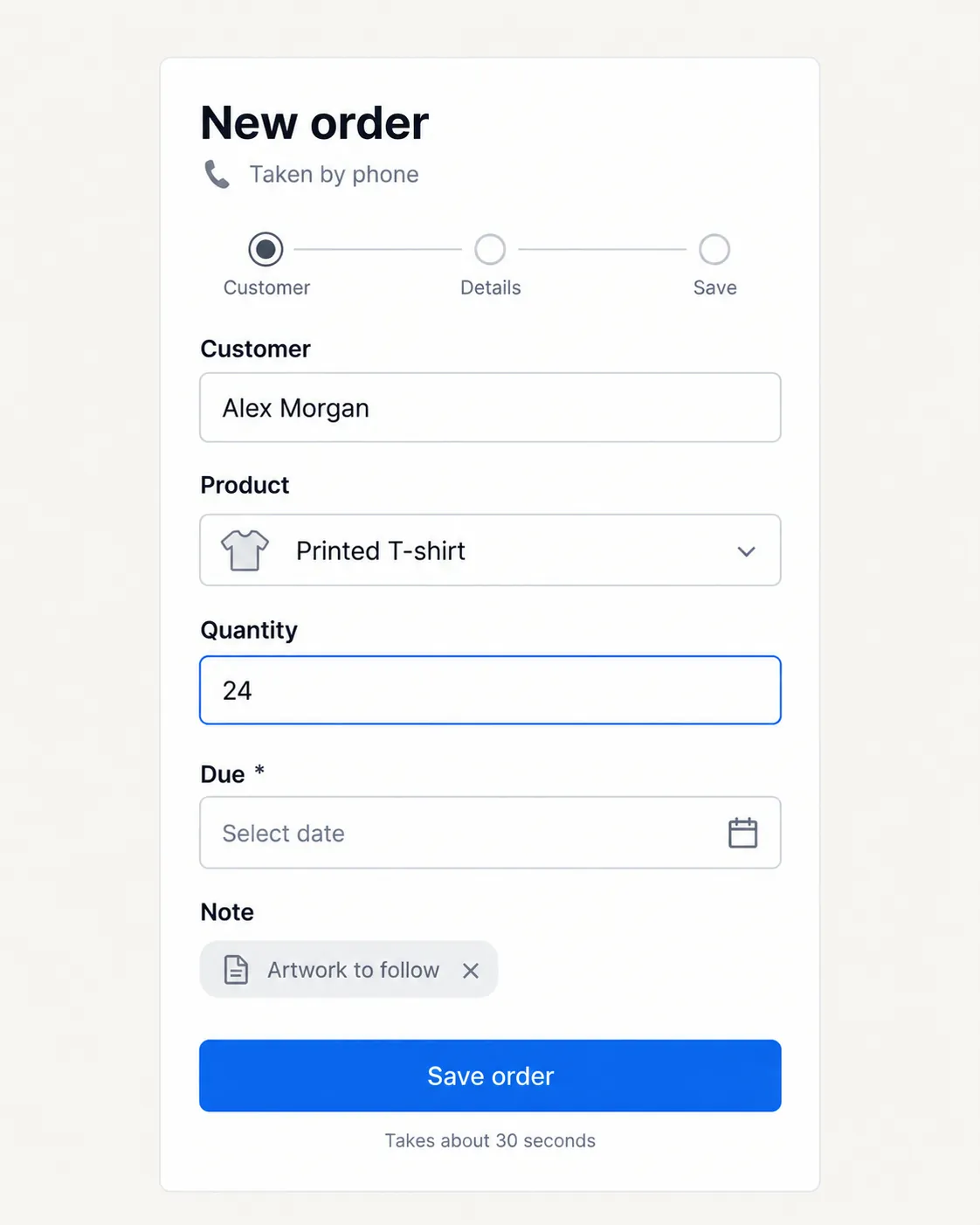
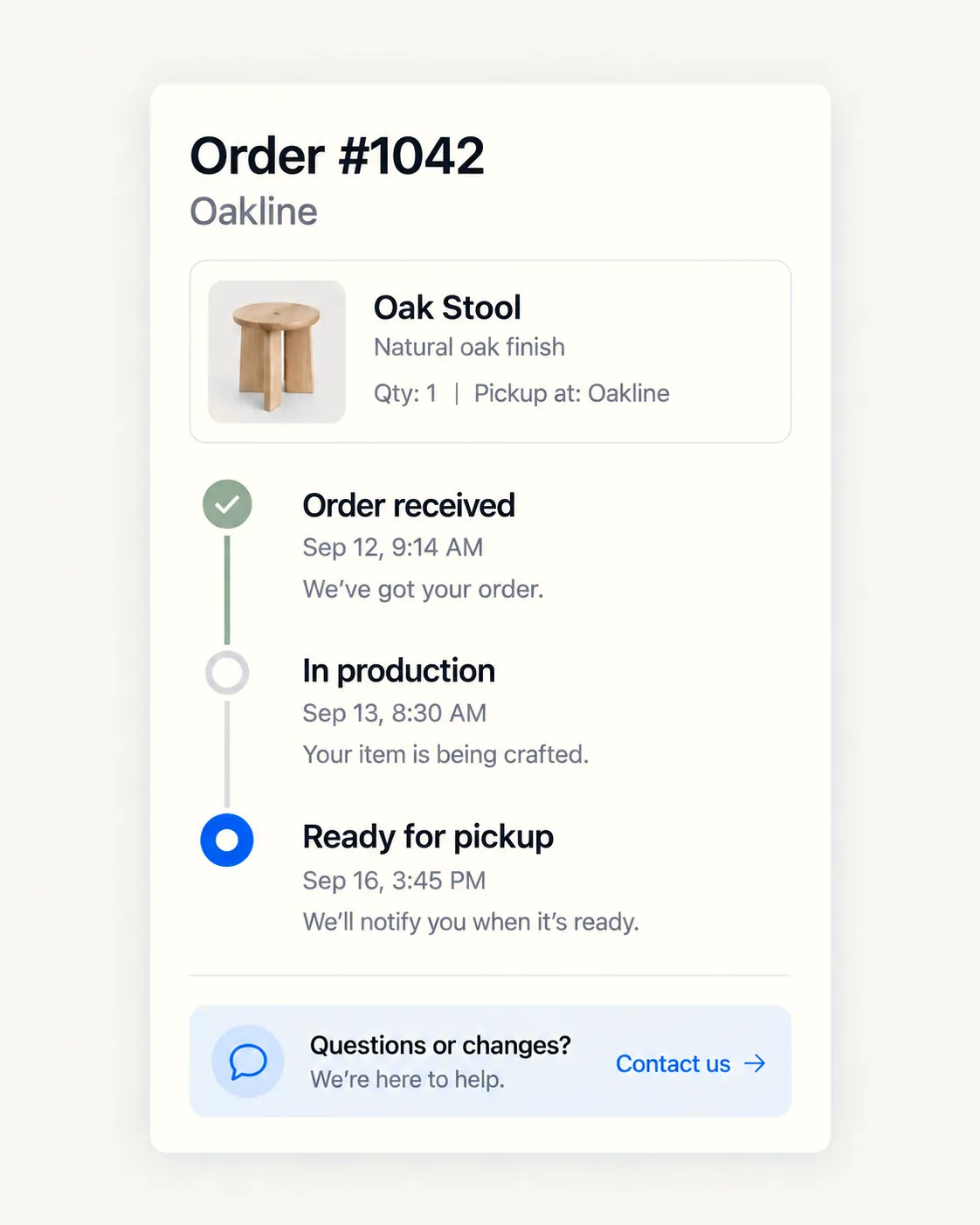
This is the one on the list most likely to be a setup rather than a build. If you already run a CRM or a job tool, the queue probably exists and nobody has configured it.
That is a few hundred dollars and an afternoon instead of a few thousand and a month. I will tell you which case you are in before quoting anything.
Roughly what a build like this involves.
The work is mostly deciding what an order actually is in your business: which fields are always needed, which are sometimes needed, and which are the ones people forget to ask for and then chase on Thursday.
That conversation takes an hour and it saves the project. Everything after it is routing.
- From you
- An hour on what an order needs, plus a few real recent ones
- From me
- Form and queue built, channels routed in, walkthrough recorded
- Live in
- 1–3 weeks
- Starts at
- $400 as a setup, $1,000 as a custom queue
The three objections I hear
My staff will not fill in a form during a phone call.
They will if it takes twenty seconds and replaces writing on a docket. The form gets designed around that call, not around a database — four fields visible, the rest optional and hidden, and no dropdown with sixty entries in it. If it is slower than the notebook it loses, and it should.
We already have a CRM. Do we need another thing?
Probably not. Most CRMs have a queue nobody has configured and a form nobody has connected to the website. If yours does, this becomes a setup rather than a build and costs a fraction as much. I will look before quoting.
Customers will keep messaging us on Facebook anyway.
They will, and that is fine. The point is not to force customers into one channel — it is to make every channel end up in the same list. Somebody still reads the Facebook message; they just log it in thirty seconds instead of remembering it.
How many channels do your orders arrive through?
Tell me, and I will say in writing whether this is a setup on what you already own or something worth building. Free either way.