
An assistant that knows your prices.
An illustration of what I set up, not a client project. The difference between AI that gets used and AI that gets quietly abandoned is almost never the model. It is whether anybody connected it to the company's own material and gave it a specific job.
Everybody in the office has an account. Nobody uses it for work.
It was switched on and then left alone.
Somebody signed up, tried it for a week, got text back that could have been about any business in the country, and stopped. Nothing had been loaded into it. Nothing had been connected to it. Nobody had been told what was safe to paste in, so the careful people avoided it and the careless ones did something you would rather they hadn't.
The fix is unglamorous and takes about a fortnight: a business-plan workspace, the company's real documents in it, two or three defined jobs, written data rules, and an hour of training on work the team actually does.
The defined jobs are the part people skip. "Use it for whatever you like" produces nothing; "draft the reply to a specification enquiry using our price list and our standard lead times" produces something worth reading. Two or three of those, chosen from what the office already does every week, is the whole difference.
- Who it fits
- Any business where the same kinds of emails, quotes and descriptions get written weekly
- First version
- Workspace, knowledge base, two or three use cases, data policy, training
- Time to live
- 1–2 weeks
- Typical range
- $800 – $3,000, plus the per-seat platform cost
The parts that matter
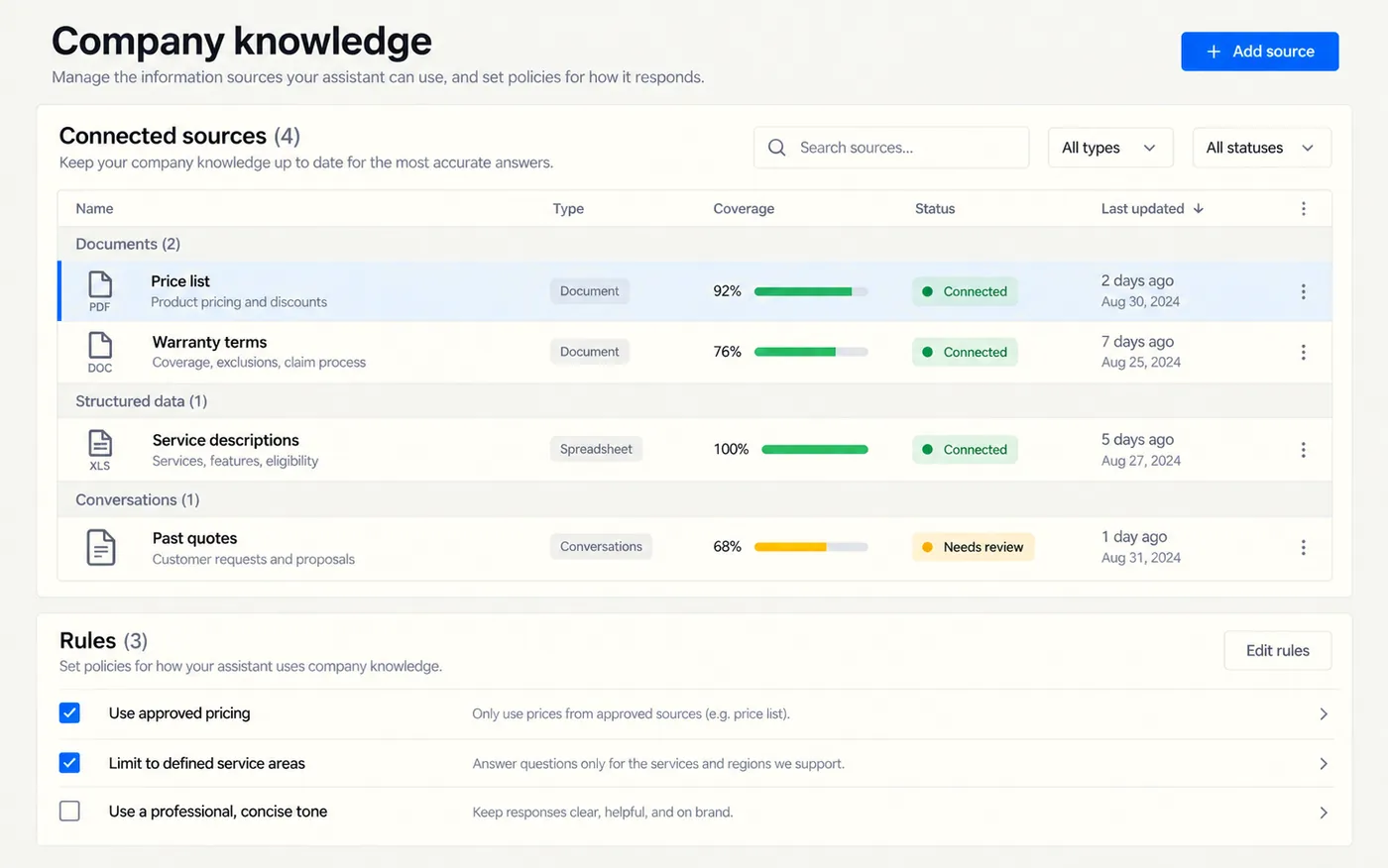
- Company knowledge
- Price list, service descriptions, warranty terms and past quotes loaded, and kept current rather than loaded once
- Defined jobs
- Two or three specific tasks it does every week, instead of a general-purpose box nobody knows what to type into
- Drafts, never sends
- Everything that reaches a customer is read and approved by a person first
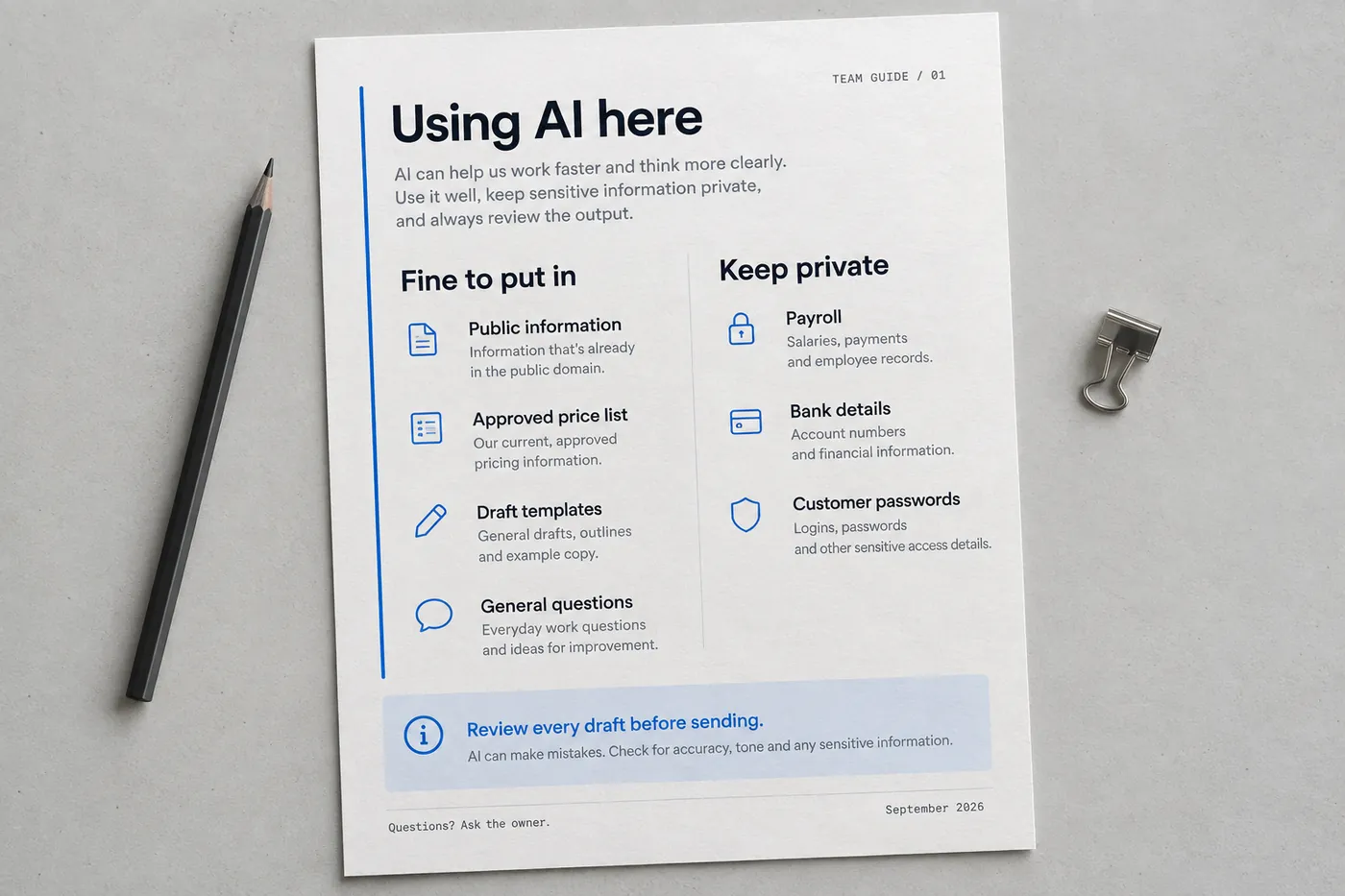
- Data rules
- One page: what may go in, what may not, who has access, what to do when it gets something wrong
- The right plan
- A business or team plan where your content is not used for training, with the setting shown to you rather than described
- Training
- One hour, in plain language, on the work the team already does
What it is allowed to know, and what it produces.
What this thing is, and what it is not.
It is a colleague with a good memory…
It has read your price list, your templates, your past quotes and your manuals, and it drafts from those. It is fast, it never gets bored of the fourteenth near-identical product description, and it shows you which document each answer came out of.
…and it is not a decision-maker
Everything it produces is a draft waiting for somebody to press send. It has no authority to price a job, promise a date, or answer a customer on its own. Anyone selling you the version that does is selling you a support ticket six months from now.
A month after setup, is anybody using it without being reminded? If not, something was set up wrong — usually the wrong job, or the documents were never loaded properly.
That is a fixable problem and I would want to hear about it, rather than have it quietly stop being used like the account you already had.
Would this survive contact with your week?
That is what the audit answers: which repeated jobs in your business this is genuinely good at, which ones it would quietly make worse, and what the first one would cost. Free, in writing, no call needed.